Here is my video to debrief OT 640! https://youtu.be/7MSMJSndXk8
Posts
Media Project: The PlanHand
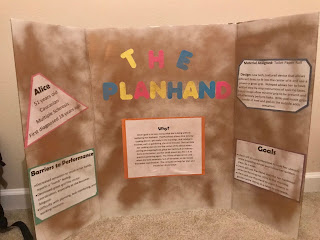
The media project I think intimidated us all as we first read the instructions and realized what we had to do. I know I first thought, "Ahh, I'm not ready for this!" It took me awhile to brainstorm how I felt my assigned item could best help Alice adapt to her MS. I really wanted to help her shower mobility since that seemed like such a dangerous situation but with a degradable item, that was a challenge. The first idea that hit me was some sort of cuff made by the empty toilet paper roll cut in half around her forearm connecting to something to her hand. Then, I thought about her fine and gross motor coordination deficits along with her decreased sensation in her hands. I tried to focus the purpose of my creation around her goals which were to keep doing what she's doing. I then began thinking how I could turn this mystery arm-bracelet-hand-helping-machine into helping Alice prepare dinner, get ready in the mornings, and organize her thoughts....
Neuro Note 4: Rolling Grizzlies
I had the rewarding opportunity to go watch a basketball practice of the Division 1 team named Rolling Grizzlies of Memphis! I had never heard of this team nor really knew wheelchair basketball was performed at a national level so this was all a new experience. Before the practice began, the coach came over to us and briefly explained the concept and how they play by the same rules as NCAA College Basketball with minor differences such as two pushes on the chair counts as a travel. He tells us about some of the players, one of which was on his way to the NBA before his injury. Another player had some sort of disease where he was once paralyzed and played wheelchair basketball in college but is now able to walk. Another teammate was also able to walk but we weren't given his story. I found it interesting they were still allowed to play on the team. As they all entered the gym, I noticed how they were transferring out of their typical chair to the...
Neuro Note 3: Trans Fatty Lives
Trans Fatty Lives is a documentary about a man named Patrick O'Brien who was diagnosed with ALS at the age of thirty. Prior to his diagnosis, his persona was TransFatty and he enjoyed making music, films, and artistic photography and continued his passion of these things throughout his ALS journey. At the time of his diagnosis, he was making a film about an old restaurant he loved named Howard Johnson's. He asked his film crew to instead turn the cameras onto him once he was diagnosed with ALS. Patrick seems to be dedicating several messages and his story to a little boy, his son, who we aren't sure about until later. This documentary took me on a very emotional ride where I often was laughing while I had tears running down my face. Patrick had a great way of turning the unthinkable into some odd humor that you couldn't resist laughing at. For example, in one very powerful scene where Patrick was pleading to not have a tracheotomy as he was gasp...
"Inside the O'Brien's" Reflection

"Inside the O'Brien's" was such a touching book and I am so happy I had the opportunity to read it, especially as we learn about Huntington's Disease. Throughout the story, I oddly found myself laughing which was a weird sensation but I love the dry humor the author still applied considering the circumstances of what Joe and the family were going through. There were many events leading up to Rosie wanting Joe to go to the doctor because things were just really off. Getting dressed one morning, he couldn’t find his gun anywhere and was convinced his wife or kids hid it from him or misplaced it but no one had placed it where it was found. During this incident, he expressed extreme rage to his family that took everyone aback. Pouring drinks into the dinner glasses one night, his grip completely gave out and the glass pitcher shattered on the table with everyone looking around in confusion. While working, he s taggered getting out of his car one day and...
My Beautiful Broken Brain - Neuro Note 2
Lotje Sodderland is a 34-year old woman who sustained a inter-cerebral hemorrhagic stroke as she was home alone in her apartment. She became overcome with confusion, disorientation, and could barely bring herself to get off her bed. She found it in herself to get out of her apartment and to a place downstairs where she collapsed in their bathroom where people saw her and were able to call an ambulance. Lotje woke up feeling confused and didn’t remember much but she had full motor ability and showed no physical signs of stroke. In a short amount of time, her family and those treating her noticed severe cognitive delays and deficiencies in her language, logic, memory, reading, writing, and occasionally her sensory perception. She would begin a sentence and suddenly forget what word to use, would recognize an object but couldn’t remember the word used to describe it, couldn’t write her name or words, and couldn’t read. As someone who used to be i...
Sensory Integration Frame of Reference
The Sensory Integration (SI) frame of reference focuses on how the interaction between the sensory systems including auditory, vestibular, proprioceptive, tactile, and visual systems, provides integrated information that contributes to a child’s learning and adaptive behaviors. The key consideration is that children have the abilities to make adaptive responses to constantly changing sensory environments. Interventions using the SI frame of reference include use of therapeutic equipment to provide children with various sensory opportunities, with at least two of these three sensations ( tactile, vestibular, and proprioceptive ). Sensations are provided in a structured environment, graded to a greater or lesser intensity depending on the needs of each child. The outcome of successful sensory integration is the participation in daily life activities and will enhance fulfillment of the children’s roles, like being a student in the classrooms that include constantly changing sensory i...
Session 22 for Make-Up
In relation to public health, AOTA's Vision 2025 considers health to be the wellbeing of one's mental, physical, and social state in the population we serve. Some key signs that you are healthy are having the ability and energy to perform the occupations that have meaning to you as well as when your mind isn't racing, resulting in stress. Occupational therapy-directed health promotion is the client-centered use of occupations, adaptions, or alteration of context to maximize the pursuit of health and quality of life for people, groups, populations and communities. There are primary, secondary, and tertiary interventions that aim to reduce threats to health that include prevention, reducing risk of a condition or injury, and limiting the impact of an ongoing illness. OTs are set apart from other professions in health promotion by how they p rovide recommendations and training for caregivers, d etermine whether patients can live independently, a ddressing existing d...
Social Determinants of Health
In Professor Flick's lecture today, the social determinants of health were brought to my attention. I am kind of embarrassed to say I didn't begin to think of most of them because they are things I am fortunate to have, such as food, shelter, and peace. Some of the social determinants such as income, sustainable resources, and education are the ones I first thought of since those are the things I am most familiar with people having or not having access to. The videos she showed us about health literacy are also new areas I haven't had a lot of knowledge or learning in. After watching those videos, I will now be more aware of my surroundings and think of the situations others may be in and make them as comfortable as I possibly can when they are in my care.
Neuro Note 1: Spinal Cord Injury
Me Before You is about a man, Will Traynor, in his thirties who was struck by a motorcycle as he was crossing the street and sustained a spinal cord injury which left him quadriplegic, paralyzed from the chest down. The accident resulted in Will losing his physical abilities, girlfriend, vibrant, intense life and residing in a castle with his mother and father where he has his own annex and staff to care for him. The Traynor family was in search of a new caregiver for Will which is how they meet Louisa Clark who goes to the castle to interview for the job to help support her parents who are struggling because her father was unemployed. Lou, for short, get's the job and meets Nathan who is the primary caretaker of Will who performs his activities of daily living each day as well as takes him places and helps lift him to and from. Nathan explains to Lou, who is feeling discouraged about her rigid and cold encounters with Will, how to just give him time and patience...
Home Health Occupational Therapy
Mandy Chamberlain begins her discussion about home health with Monika Lukasiewicz by hearing how Monika was first exposed to OT through a personality test and how she loved that OT is both a science and an art. She loves the creativity of home health OT and it has allowed her to practice in the ways that she wants to because she gets to be in people's environments and really maximize her skills. For example, when assisting a client with her independents shower skills, she said it is very beneficial to see her actual shower setting and make modifications based off of her individual needs in that shower. She thinks where home health shines is that they get to see the big functional picture for people while being in their environment and getting a special look at safety i.e. fall prevention, how are they taking their meds, performing ADLs. Monika described a typical day as an OT in home health as most mornings she goes to the office to make phone calls and/or follow...
"Gray Area" in Inpatient Rehabilitation OT
While observing as an OT school applicant in the inpatient rehabilitation of a prominent hospital in my home town, two key things that stuck out to me were the repetitive uses of exercises and seeing many clients with a lack of motivation to perform the tasks. Now that I've been in OT school for nearly four months, I know that these things could be correlated with the correlation being that the clients weren't given therapeutic exercises or preparatory methods that had meaning to them. Very often I observed clients who either didn't want to go to therapy or got to therapy and were dazing off or skipping through the exercises just so they could leave. While there were not limited resources at the hospital, case load from day to day on the OTs was at an extreme high. On a typical day, every OT would have a client every 30 minutes and very often have two at a time during a session. I know that the OTs wished they could do more meaningful activities with their ...
OTPF
The OTPF contains all things occupational therapy. Each day we see some sort of snippet from the OTPF in each one of our courses which shows us how it contains so much pertaining to what you need to know about occupational therapy. If we have any questions regarding what occupations are or the process we should use in evaluating the patterns or skills in one's performance for example, we know we can find all of these things plus more in the OTPF. To give a little taste of what we've seen in the OTPF so far, I decided to list some examples from our courses we're currently enrolled in. In our Foundations of Occupation Centered Practice course, we have used the OTPF to evaluate the domains and process of OT as well as client factors. In Evidence Based Practice, we have used the OTPF every single day in class for, just to name a few, forms of evidence and outcome measures. In our Leadership of OT course, we have used the OTPF when discussing the vision of...
Era Presentation
One thing I was really interested in was how much occupations involving play/leisure have changed in just 70 years as technology and culture progressed. From what I gathered from a collection of all of the groups is that the war had a lot to do with such change in society. In the 50s, leisurely time consisted of being outside or outings with friends with the people of that era having the first skateboard and dancing to the Jive. With the release of television, Nintendo, Gameboy, and the internet (just to name a few) the 2010s group had a great representation of how much more time people were spending inside and/or in less active ways with a graph that showed the plethora of screen time and little to no exercise. OTs can play a vital role in helping people come up with more creative ways to spend their time!
SCLV Specialty Certification
In a sense I feel I am addressing both blog entry options in that I was unaware of OT practice in the field of ophthalmology and I also find it to be the most interesting specialty certification. My initial interest arose from my own multiple struggles with vision since I was about seven years old. I feel as if there's a deeper passion in your day to day work when you have some personal connection or empathy in what exactly you are doing. Hence, once of the reasons I chose occupational therapy since empathy is one of our key foundations! Reading about SCLV on the AOTA website is the first knowledge I have of what low vision actually is. When first thinking of low vision, I thought it was likely to be for those who commonly struggled to see without visual aids or surgery. From the AOTA website I learned it is actually far more complex and defined as a condition limiting a person from performing everyday activities and the vision cannot be corrected by lenses...
Occupational Therapy in Mainstream Media
I was intrigued by this article because it laid out some key foundations of OT in a very simplistic way for some with very limited knowledge of the practice to understand. However, two things I didn't fully agree with is "OT focuses on what you NEED to do" and "what you are EXPECTED to do" although on that second part I feel they were referencing the statement from a cultural point of view. https://www.buzzfeed.com/gsuot/occupational-therapy-the-greatest-career-no-one-h-2as55?utm_term=.fwRAdWmWGM#.jdM8nJyJGV